
The Rupture They Needed
My Testimony - by Stephen Brewer | Part 9

There are moments in life that feel private—until you realize they weren’t. Moments that break you open not only emotionally, but strategically. My relationship with Brandon Hilpert was one of those moments. When it ended, it felt like a breakup. When I spoke out, it felt like a reckoning. But looking back now—with the patterns I’ve uncovered, the silences I’ve endured, and the retaliation I’ve documented—it’s clear that the breakup didn’t mark the beginning of a psychological operation. It marked an escalation. What had long been operating in the shadows began to surface—and this testimony is where it begins to show its face.
Brandon Hilpert and I were in a committed long-term romantic relationship from October 2010 until January 2016. Our connection was meaningful and formative—woven into the heart of my time in San Diego—and it ended abruptly, without clear explanation. Brandon asked me not to speak publicly about the breakup. The request was verbal—I never signed anything—but it set the tone for what followed.
The breakup was destabilizing, both socially and emotionally. His silence led to mine, and mine carried consequences: the sudden loss of close friendships, confusion within our shared circles, and a deepening sense that something had broken not just privately, but socially and politically as well.
I was left to shoulder the blame alone.
The early years of our relationship were marked by warmth, connection, and a deep sense of mutual understanding. We shared holidays, friend circles, and a sense of possibility rooted in civic life and queer community. Brandon was thoughtful, idealistic, and deeply committed to public service. I was a grad student in psychology building a private practice and navigating both academic and clinical life. We often encouraged each other in our respective work—his in public accountability, mine in trauma and healing.
But in the final year, that rhythm began to change. Our intimacy grew inconsistent. Brandon seemed increasingly distracted—emotionally present at times, but also withdrawn and harder to reach. He no longer looked me in the eyes with the same steadiness. Small details began to feel off: miscommunications that never quite resolved, weekends that didn’t unfold as planned, friends becoming distant for reasons I didn’t understand.
I now understand these moments as precursors—not just to the end of our relationship, but to something more orchestrated. A quiet fraying that didn’t feel accidental. I had no framework then for psychological operations or narrative destabilization. But I felt it in my body: a growing unease, a sense that something was moving around me, not just within me. That confusion would only deepen in the months ahead.
The breakup was destabilizing, both socially and emotionally. His silence led to mine, and mine carried consequences: the sudden loss of close friendships, confusion within our shared circles, and a deepening sense that something had broken not just privately, but socially and politically as well.
What I didn’t share publicly at the time—and what I’ve only recently been able to articulate—is the depth of what happened in the final year of our relationship. The event that shattered my sense of safety wasn’t the breakup itself, but the surprise 40th birthday party in September 2015 that I was intentionally excluded from helping plan.
For months, I had been trying to coordinate something meaningful for Brandon. I had reached out to his mother, sister, and roommate. Instead, I was shut out of the planning process and, in a moment I can only describe as orchestrated, watched as our closest friends gathered to celebrate him—without me.
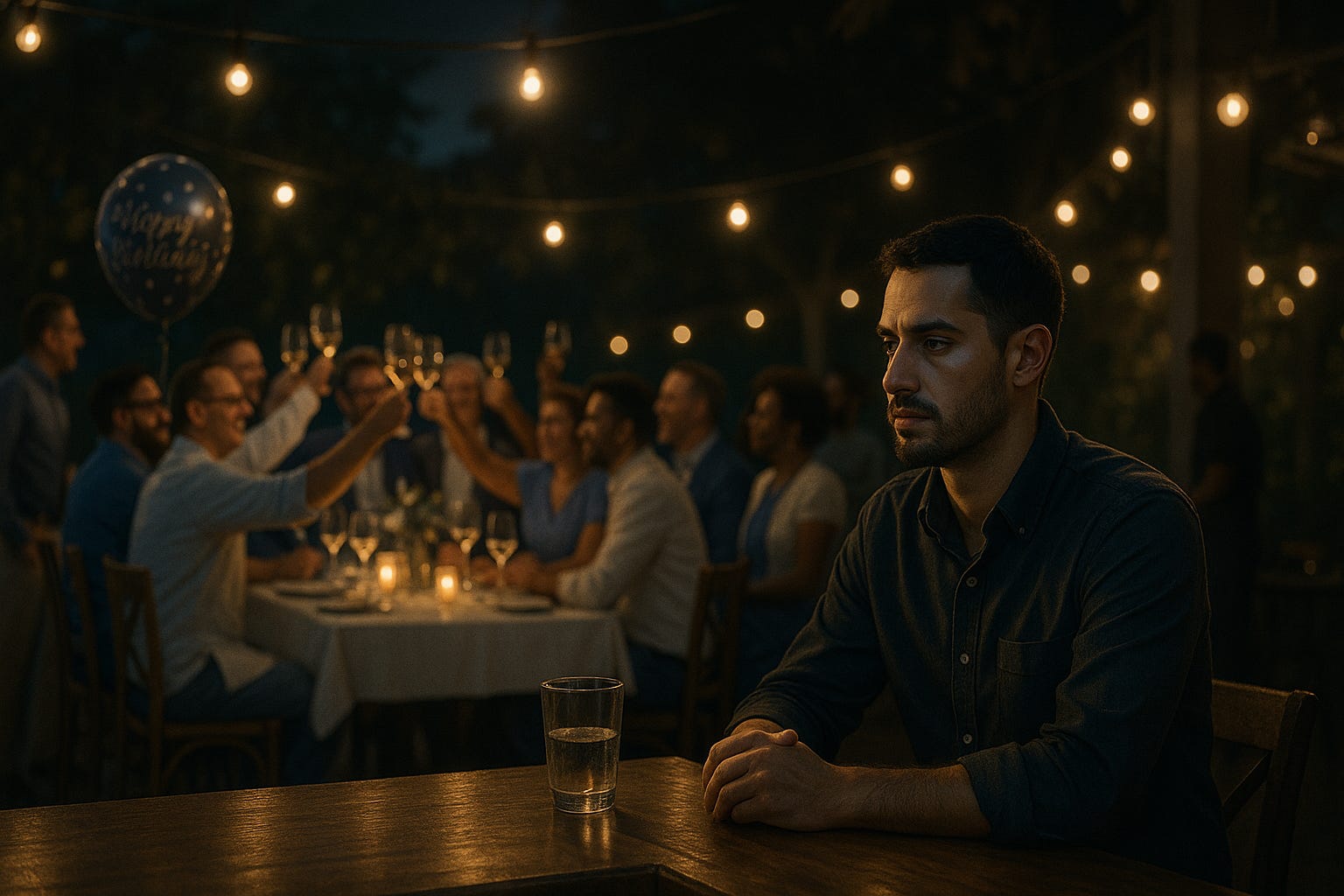
I was at that party. I sat at the bar. I held myself together. But inside, I was fracturing. I had been excluded by people I trusted—intentionally and publicly—and the message was clear:
I no longer belonged.
That night marked the beginning of what would become a spiritual and psychological unraveling. The betrayal wasn’t just relational. It was systemic. The people who celebrated Brandon that night were the same people I had called family. People I had trusted. And from that moment forward, I became untethered—from them, from him, from myself.
In the weeks that followed, I tried to repair the rupture. I offered explanations, shared message receipts, and even planned a trip to try and make up for what I hadn’t been allowed to do. But the damage had been done. In January 2016, Brandon told me the relationship was over. He asked me not to talk about it publicly. I honored that request—for years. Even as I died inside.
What followed over the next ten months was not just a breakup. It was the death of my chosen family, the implosion of my identity, and the beginning of a ten-year descent into what I can only describe as a prolonged dark night of the soul. I lost my sense of reality, my community, and eventually, my livelihood. And while others moved forward, I stayed in that moment—frozen—trying to understand how love could be weaponized, how friendship could be coordinated into silence, and how I could be erased from my own story.
I have spoken previously of what happened in Florida, and how coercive control operates. But I now believe that the playbook was already in motion long before I arrived there.
As I reflect now, the final year of our relationship was marked by subtle but accumulating signals that something was shifting. I now believe our relationship was destabilized in part by external actors. When Brandon and Chris Allbritain became a couple shortly after, the pieces began to fall into place. The public humiliation, the exclusion, the unexplained change in emotional tone—it no longer felt like coincidence. It felt like removal.
Allbritain was a Vice President of a pharmaceutical company—an industry I had long criticized in both academic and clinical settings. As a psychologist trained in research methods and epistemology, I had deep concerns about pharmaceutical influence over mental health policy and practice. In one early conversation, I remember Allbritain attempting to defend Big Pharma’s medication development pipeline. He described it as rigorous and peer-reviewed. I responded by pointing out the file-drawer effect—where negative findings often go unpublished—and questioned the integrity of an evidence base largely funded by the same companies profiting from the results. While researchers are ethically bound to objectivity, I reminded him, incentives often shape outcomes. Most researchers need to publish to survive, and those working under industry sponsorship tend to produce “favorable” findings. My challenge to the research culture was not personal, but principled.
Still, I sensed tension from that moment on. I now suspect—though I cannot prove—that Allbritain may have used that disagreement, and my broader anti-pharma stance, to undermine me privately and subtly distance Brandon from me.
In light of what I have experienced in the years since, Allbritain’s behavior fits a broader pattern: the quiet deployment of social destabilizers to isolate and discredit those who have been marked. The same kind of tactics I would come to recognize elsewhere—within systems, institutions, and psyops. I believe now that Allbritain may have been placed—or manipulated—into position to disrupt our bond, intentionally or not.
In the years that followed the breakup, I kept my distance. I tried to move on. Brandon and I were no longer in contact after October 2016. But the pain didn’t fade, and unresolved trauma has a way of surfacing when the conditions are right—or wrong.
In December 2018, I began having a series of vivid dreams involving Brandon. Over the course of several nights, the dreams followed a consistent emotional thread: Brandon was in visible distress—sometimes crying, sometimes lost, always unreachable. The images lingered long after I woke. At the time, I couldn’t explain why they affected me so deeply. But the emotional content was unmistakable. I remember waking with a strong, almost visceral sense that something was wrong—that he was hurting, and that the pain I was witnessing in dreamspace was real. I had no contact with him and no outside information to explain the timing. Then, in April 2019, I learned—under most unfortunate circumstances—that Brandon and Chris had broken up. The news struck me as confirmation of what I had sensed months prior. While I cannot claim to know the full truth, I now view those dreams as a form of unconscious attunement—a psychic echo of distress traveling through unresolved attachment and unspoken history.
In 2022, while living in Florida and experiencing severe coercive control and torture from Rowan, I found myself isolated and retraumatized. Memories of Brandon resurfaced. My nervous system was in collapse. The last person Rowan set up to have sex with me - the last time I was sexually trafficked by Rowan, on or about November 11, 2022 - mentioned after he was finished that he had recently moved to the area from San Diego.
That comment—about having just moved from San Diego—struck me as more than coincidence. In the altered psychological state I was in, it landed like a cue. Not a direct order, but a subtle, behavioral signal. A breadcrumb. It bypassed my reasoning mind and activated something deeper—an unconscious script I had been conditioned to follow. In hindsight, it feels like part of a psychological feedback loop—coercive, layered, and strategic. I now believe I had been primed over time, through emotional trauma and repeated violations of consent, to respond to such cues automatically. The result was a compulsion: to return to San Diego, to make a public disclosure, and to carry out a function I didn’t yet understand had been engineered.
Leading up to Thanksgiving, I made a series of emotionally vulnerable Facebook posts—some cryptic, others more direct—indicating that something long-buried was surfacing. These posts, made public at the time, culminated in a disclosure.
Looking back with the benefit of distance—and having now traced the patterns described in the preceding chapters—I no longer believe the disclosure emerged solely from conscious deliberation or personal resolve. I believe I was manipulated into making the post. Not in a single moment, but over time. Through accumulated conditioning, coercive control, unresolved trauma, and external actors who saw my vulnerability as a tool. At the time, I believed I was speaking out for justice. And I was. But I now understand that my pain was being instrumentalized—nudged forward at just the right moment to destabilize Brandon, and by extension, the institutions he represented. It doesn’t negate the authenticity of my experience. But it complicates the origin of the disclosure. I thought I was finally acting on my own terms. In reality, I was walking a path that had been quietly laid out for me by others—some of whom I still cannot name.
At 8:11:49 a.m. on November 21, 2022, I posted a public letter on Facebook addressed to San Diego Mayor Todd Gloria, alleging that I had been sexually assaulted by Brandon during our relationship. By that time, Brandon had become Chair of the San Diego Commission on Police Practices. I tagged the Mayor, the Commission, and the San Diego Police Department directly in the post. This was not performative—it was a direct appeal for institutional recognition and redress.
The institutions surrounding Brandon seemed indifferent, or worse, actively protective of him.
The letter was written and published while I was in a state of acute distress. I had been experiencing flashbacks and emotional flooding—symptoms I now recognize as trauma resurgence. I was also sleep deprived, as in the nights prior to my disclosure, Rowan had repeatedly and intentionally shined a mag light in my eyes as I was going to sleep — triggering night terrors.
The next morning, on November 22, I followed up with a private post to friends. In it, I explained that I had spent over a year deliberating, speaking with colleagues, and preparing for what might come. I acknowledged that I was the only person I knew who had made such a claim against Brandon, and I said clearly that I didn’t expect prosecution or media engagement. I wasn’t trying to destroy anyone’s life. I wanted an apology. I wanted closure. I acknowledged the dishonor in Brandon’s silence and the complicity of those around him, even as I braced myself for it.
But even so, I now believe that the deliberations I undertook—what I thought were careful, independent decisions—were shaped by powerful external influences. Chief among them was the high-control spiritual group I had been entangled with in Florida. As described earlier, that group operated with methods that blurred the line between healing and indoctrination. Over time, it destabilized my cognitive anchors, encouraging intuition over logic, obedience over autonomy, and energetic surrender over critical thinking. These dynamics didn’t disappear just because I left. They lingered in my psyche—priming me to interpret trauma resurgence as a spiritual imperative, and public disclosure as a kind of karmic reckoning. In that fog, my clinical training was one of the only safeguards I had left. It grounded me just enough to document what I was experiencing, to question my perceptions, and to create structure amid the flooding. But even that was tenuous.
I was not well.
And the line between agency and manipulation had been rendered almost imperceptible.
In trauma psychology, memory is not always linear. Flashbacks and emotional flooding can feel more real than the original event, especially when they surface in isolation. This non-linear nature of trauma memory—where flashbacks feel more vivid and present than the original events—was likely exploited by those manipulating me. The resurgence of symptoms made it easier to cast doubt on my credibility, to frame my experience as instability rather than resurgence of truth. In hindsight, it appears that my trauma responses were not only anticipated, but strategically leveraged. The intensity of my emotional state made me both more vulnerable to suggestion and more likely to act in ways that could later be discredited. Those pulling strings knew how to time the triggers. They knew how trauma floods perception. And they counted on my reaction being dismissed as unhinged rather than understood as a symptom of systemic harm.
My post was a rupture.
A public cry for integrity and justice in a world where silence had become a survival strategy and no longer was sufficient.
It was also a coded cry for help from that part of me that was still tenuously guarding me. At that point, I didn’t know who I could trust—not in San Diego, not in Florida, and certainly not within the institutions that had turned silent or hostile. But I believed, perhaps irrationally, that if I went public—if I spoke in a way that pierced through the fog—someone would see me. The right eyes. The ones who understood how these systems work, who recognized the language of trauma under pressure, who knew that truth doesn’t always arrive in perfect form. I hoped that someone on the inside, or adjacent to it, might guide me—quietly, even covertly—toward safety.
It wasn’t just a disclosure.
It was a signal flare.
What followed was not justice and protection, but containment.
Shortly after the post, on November 25, 2022, the day after Thanksgiving, I received a call on my private practice phone number from Brandon’s attorney, Shawn Huston. He introduced himself as Brandon’s counsel and said that Brandon was “concerned about some Facebook posts that are affecting his employment.” Huston emphasized that Brandon and I had broken up seven years earlier, and asked why I was bringing up the past. I told him there were unresolved matters between us—that all I wanted was the truth and an apology. He responded that Brandon likely could not apologize because it might incriminate him. Huston stated that Mayor Todd Gloria’s office was starting an investigation due to my open letter, though I had not been contacted by the Mayor’s office or the District Attorney at that point.
He asked if I had an attorney, therapist, or someone to talk to about “all this,” and specifically asked if I knew Josh Mullholland. Huston emphasized his background as a former prosecutor. He offered to facilitate some form of communication with Brandon, suggesting there might be a way to answer my questions without Brandon incriminating himself. I said I was open to ideas and expressed tentative interest in an email exchange—but that I would need to consult with counsel before agreeing. It was, after all, a holiday weekend. Huston asked multiple times for a retraction, though I did not recall hearing the phrase “frank and full.” I explained that I had told the truth and shared my opinions, and that a retraction stating otherwise could expose me to a defamation suit. Throughout the call, I reiterated that what I truly wanted was peace, honesty, and resolution—to understand what had happened between us in those final years, and to move on.
Wanting to resolve the matter in good faith, I proposed that we work through the San Diego Restorative Justice Mediation Program (SDRJMP). They agreed to facilitate.
In retrospect, I now believe I was manipulated—both psychologically and situationally—into destabilizing Brandon and, by extension, the San Diego Commission on Police Practices, a body Brandon had in large part established. At the time, I believed I was acting with integrity. I thought that by sharing my trauma publicly, I was seeking healing, resolution, and accountability. But I now see how my disclosure—its timing, its public framing, and its institutional targeting—aligned with the objectives of those who benefit from disruption and discreditation. I had become a vector. A pressure point. A pawn in a larger operation I could not see. I was operating on instinct—my own pain, my own desire for truth—yet those instincts had been conditioned, primed.
What felt like deliberation was, in part, compulsion.
And what felt like empowerment was, in part, orchestration.
Between January and May 2023, I met multiple times with SDRJMP facilitators—Xiani Williams, Ian Ragsdale, and Leah Gage. I provided background on the relationship and my goals for healing and accountability. I participated in two formal facilitation sessions. In March 2023, SDRJMP informed me that Brandon had met with them.
In April, I sensed something was off. Under Marsy’s Law, victims of crime in California have a right to timely investigation and to be treated with dignity and respect. Yet five months had passed since my public accusation—and I still had not been contacted by law enforcement. No interview. No acknowledgment. Nothing. Given my training in forensic threat assessment and police psychology, I knew that law enforcement agencies often monitor public social media profiles for threat signals, credibility cues, or behavioral indicators. So I acted preemptively. I made a private Facebook post explicitly asserting my rights under Marsy’s Law. It wasn’t performative—it was protective. I needed to create a documented record that I was invoking my rights in good faith. If I was being watched, I wanted them to see that I knew the law—and that I expected it to apply to me, too.
In May, SDRJMP scheduled a confidential video session for me to deliver a recorded message. I met facilitators at their Jefferson Street office and created the recording on June 1, 2023, at 1:00 p.m. Mr. Ragsdale stated he anticipated the mediation process would conclude in August.
On or about June 3, 2023, I felt a shift that will be described in detail in later parts of my testimony.
On June 14, 2023, I was contacted by an investigator for the San Diego Commission on Police Practices (CPP). Debra Reilly, a private contractor retained by CPP, reached out to me via Facebook Messenger after reportedly failing to reach me by phone. This seemed bizarre to me, as I had no missed calls from her. She informed me that CPP had initiated a fact-finding investigation based on my November 2022 disclosures.
We met by Zoom on June 21, 2023. The meeting was recorded by Ms. Reilly. She stated that her investigation would take approximately one month and would likely conclude in August. When she began asking questions about the Facebook posts, I raised my hand to stop her and asked if she was aware that Brandon and I were engaged in mediation through SDRJMP. She said she was not, and stated she would consult with the CPP Executive Director before proceeding.
After this meeting, I emailed SDRJMP to inform them of Ms. Reilly’s investigation, and to coordinate with her as needed.
On June 22, 2023, SDRJMP acknowledged my outreach and stated they would reach out to Brandon to “see if we could finalize this mediation.” They also stated that they would not share details of the mediation with Ms. Reilly, except for the fact that Brandon and I were in mediation.
On June 27, 2023, Ms. Reilly informed me that she had been instructed by the CPP Executive Director to continue. She emailed me a set of written questions. In light of my active participation in mediation, I declined further involvement and reasserted my rights under Marsy’s Law. I was never contacted by her again. No findings or follow-up were shared.
The timing of CPP’s actions, overlapping with SDRJMP’s collapse into silence over the next few weeks, left me feeling exposed and abandoned by both processes.
On July 11, 2023, I emailed SDRJMP asking about the disposition of the mediation process.
On July 18 at 9:21am, SDRJMP responded and informed me that Brandon had met with the facilitators and he requested additional time to decide whether and how he wished to proceed.
I couldn’t tolerate the ambiguity anymore.
But it wasn’t just about ambiguity.
By that point, I had begun detecting patterns—subtle, disorienting, and persistent—that suggested my disclosures were triggering responses I couldn’t fully trace. Communications that arrived just after I thought something privately. Shifts in tone from people I hadn’t spoken to in years. Reactions that seemed out of sync with what was publicly visible, but uncannily timed to my internal state. I didn’t have a name for it yet. I only knew that something was moving behind the scenes—quietly, but with precision. The silence from SDRJMP and the procedural deflection from CPP didn’t feel like bureaucracy. They felt strategic. And that left me exposed, as if something larger was being tested through me.
Under immense psychological distress, I began publishing a series of public retractions. The first, on July 18 at 2:04 p.m., was addressed to Mayor Gloria and the Commission. I expressed regret for my prior statements, claimed they were made in an unsound state of mind, and requested that the matter be considered resolved.
Over the following days, I made three additional retractions—each public at the time and now archived privately. One addressed Brandon directly (July 19), one addressed his family and the WNSC community, and one was addressed to his mother, Renee Hilpert (July 21). Each post struck a tone of submission, apology, and withdrawal. They were carefully worded and widely visible. They were also made under extreme psychological duress.
On July 22, 2023, I made a brief private post. Again, knowing that if law enforcement were monitoring my social media, I would be securing my rights. It said only:
“I assert my rights under Marsy’s Law.”
The following day, I expanded in a private comment on Facebook:
“My retraction regarding Mr. Hilpert was made while I was in distress, as I was perceiving an ex-parte hearing about me. What I perceived was terrifying, as there were people who sounded focused on sending me to maximum security prison. Mr. Hilpert and/or Mr. Hilpert’s counsel used illegally obtained evidence to stalk me and pressure a retraction out of me.
I am unable to work at this time due to stress related to these actions by Mr. Hilpert and/or Mr. Hilpert’s counsel. There is truth to what I wrote to Mayor Gloria.
I am a victim of crime. I assert my rights under Marsy’s Law.”
This was a private communication made under psychological distress and was an expression of perceived harm and survivor experience. It is not presented here to assert legal conclusions or factual claims of criminal conduct.
But still, no help came.
And now I know why.
Those who could have helped me didn’t know what side I was on.
In environments shaped by Fourth Generation Warfare (4GW)—where traditional battle lines dissolve and the war is waged through narrative, perception, and identity—the individual becomes a theater. Allegiances are assumed, tested, or imposed. In such a system, truth becomes a liability, especially when it destabilizes the illusion of order. I had stepped into that terrain without knowing it. My disclosure wasn’t just interpreted as personal—it was interpreted as tactical.
Was I exposing abuse?
Or was I being used to take down someone valuable to institutional interests?
In 4GW, the answer doesn’t matter. What matters is control. And because I couldn’t be placed, because I wouldn’t submit to one side’s script or another’s silence, I became an unresolvable variable. A liability. A threat to the machinery, not because I was wrong—but because I was unpredictable.
The cost to me has been immeasurable. My reputation has been smeared. My integrity has been questioned. My silence has been used against me, and my truth twisted to fit the needs of those in power.
I include this chapter not to reopen old wounds, but to mark a moment when the silence broke and the fog thinned out. It was a turning point—a rupture that foreshadowed what would follow. The dismantling of my life, the escalation of institutional targeting, and the terrifying descent into psychological operations I did not yet fully understand.
I had misunderstood the nature of the war I was in.
It wasn’t just personal.
It was systemic.
Strategic.
Invisible by design.
Part 10 begins there—with a well-established theoretical framework based in fourth generation warfare and trauma psychology that conceptualizes my life not as a series of misfortunes, but as a theater of war. The kind with no front line.
As of this writing and to the best of my knowledge, Brandon Hilpert holds no public office. He has neither reached out to me, nor responded to the events that unfolded after my public disclosure and our attempted mediation. I am not seeking to punish him. I am seeking to heal — and to prevent what happened to me from being erased or repeated.
I want to offer something here that may surprise some readers: my sincere well wishes for Brandon and his partner, Drew. I know Drew to be a good man—steady, kind, and morally grounded. Whatever may remain unresolved between Brandon and me, I am truly glad that he found someone of Drew’s character to share his life with. Healing doesn’t always come through apologies or formal resolution. Sometimes, it comes through witnessing that those we once loved - and still love - have found steadiness, love, and meaning in their lives.
And, to be clear: I am not afraid of scrutiny. If any party believes an investigation is warranted, I welcome it. I have told the truth. I have pursued peace. I have followed every available process in good faith.
If the systems designed to uncover truth are still functioning, let them do so.
I do not fear justice.
Now, more than ever, I am relying on it.
Update 9/19/25: Included a link to Addendum B where events of June 3, 2023 and the days following are detailed.
Protected Speech | Educational Use | Forensic Testimony
This testimony reflects the lived experience of the author and is protected speech under California’s anti-SLAPP statute and the U.S. Constitution. It is offered for public education, restorative justice, and historical accuracy. No accusations are made with malice, and all statements are based on personal memory, clinical records, and survivor context.